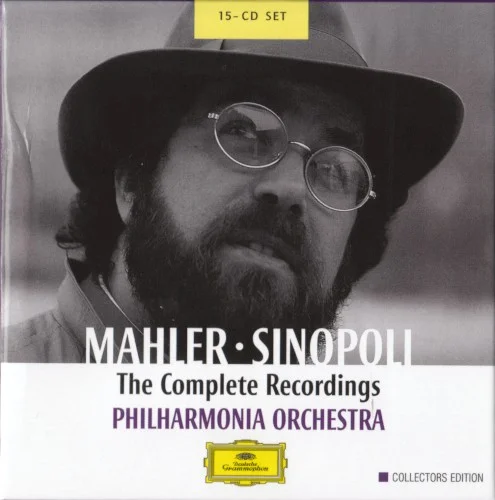
The Complete Recordings
Giuseppe Sinopoli · Philharmonia Orchestra · Sächsische Staatskapelle Dresden · Philharmonia Chorus · Keith Lewis · Waltraud Meier · Cheryl Studer · Hans Sotin · Sumi Jo · Thomas Allen
The Complete Recordings (1997), CD, on Deutsche Grammophon. Music by Gustav Mahler, performed by Giuseppe Sinopoli, Philharmonia Orchestra, Sächsische Staatskapelle Dresden, Philharmonia Chorus; 113 tracks.
Composer
Tracklist
Disc 1
Disc 2
Symphony no. 1: I. Langsam. Schleppend. Wie ein Naturlaut – Im Anfang sehr gemächlich
Symphony no. 1: II. Kräftig bewegt, doch nicht zu schnell – Trio. Recht gemächlich
Symphony no. 1: III. Feierlich und gemessen, ohne zu schleppen
Disc 3
Symphony no. 2 in C minor “Resurrection”: II. Andante moderato
Symphony no. 2 in C minor “Resurrection”: III. [Scherzo.] In ruhig fließender Bewegung
Symphony no. 2 in C minor “Resurrection”: IV. »Urlicht«. Sehr feierlich, aber schlicht
Gustav Mahler - Symphony no. 2 in C minor
Giuseppe Sinopoli, Philharmonia Orchestra, Brigitte Fassbaender
Disc 4
Disc 5
Symphony no. 3: Part II: IV. Sehr langsam. Misterioso. Durchaus ppp. "O Mensch! Gib acht!"
Lieder eines fahrenden Gesellen: I. "Wenn mein Schatz Hochzeit macht"
Gustav Mahler - Lieder eines fahrenden Gesellen
Giuseppe Sinopoli, Philharmonia Orchestra, Brigitte Fassbaender
Lieder eines fahrenden Gesellen: II. "Ging heut' morgen übers Feld"
Gustav Mahler - Lieder eines fahrenden Gesellen
Giuseppe Sinopoli, Philharmonia Orchestra, Brigitte Fassbaender
Lieder eines fahrenden Gesellen: III. "Ich hab' ein glühend Messer"
Gustav Mahler - Lieder eines fahrenden Gesellen
Giuseppe Sinopoli, Philharmonia Orchestra, Brigitte Fassbaender
Lieder eines fahrenden Gesellen: IV. "Die zwei blauen Augen"
Gustav Mahler - Lieder eines fahrenden Gesellen
Giuseppe Sinopoli, Philharmonia Orchestra, Brigitte Fassbaender
Sechs frühe Lieder: III. "Nicht wiedersehen"
Sechs frühe Lieder: IV. "Zu Straßburg auf der Schanz"
Gustav Mahler - Des Knaben Wunderhorn: Zu Straßburg auf der Schanz
Disc 6
Disc 7
Disc 8
Disc 9
Kindertotenlieder: II. "Nun seh' ich wohl, warum so dunkle Flammen"
Disc 10
Disc 11
Symphony no. 7: IV. Nachtmusik. Andante amoroso
Symphony no. 7: V. Rondo. Finale. Allegro ordinario - Allegro moderato ma energico
Symphony no. 8: Part I. Allegro impetuoso “Veni creator spiritus”
Gustav Mahler - Symphony no. 8 in E-flat major “Symphony of a Thousand”: Part II. Closing Scene from Goethe's Faust: p. "Alles Vergängliche ist nur ein Gleichnis" (Chorus Mysticus, soloists)
Giuseppe Sinopoli, Philharmonia Orchestra, Philharmonia Chorus
Gustav Mahler - Symphony no. 8 in E-flat major “Symphony of a Thousand”: Part II. Closing Scene from Goethe's Faust: p. "Alles Vergängliche ist nur ein Gleichnis" (Chorus Mysticus, soloists)
Giuseppe Sinopoli, Philharmonia Orchestra, Philharmonia Chorus
Symphony no. 8: Part I. Tempo I. (Allegro impetuoso) “Infirma nostri corporis”
Gustav Mahler - Symphony no. 8 in E-flat major “Symphony of a Thousand”: Part II. Closing Scene from Goethe's Faust: p. "Alles Vergängliche ist nur ein Gleichnis" (Chorus Mysticus, soloists)
Giuseppe Sinopoli, Philharmonia Orchestra, Philharmonia Chorus
Symphony no. 8: Part I. Tempo I. (Allegro, etwas hastig)
Gustav Mahler - Symphony no. 8 in E-flat major “Symphony of a Thousand”: Part II. Closing Scene from Goethe's Faust: p. "Alles Vergängliche ist nur ein Gleichnis" (Chorus Mysticus, soloists)
Gustav Mahler - Symphony no. 8 in E-flat major “Symphony of a Thousand”: Part II. Closing Scene from Goethe's Faust: p. "Alles Vergängliche ist nur ein Gleichnis" (Chorus Mysticus, soloists)
Giuseppe Sinopoli, Philharmonia Orchestra, Philharmonia Chorus
Gustav Mahler - Symphony no. 8 in E-flat major “Symphony of a Thousand”: Part II. Closing Scene from Goethe's Faust: p. "Alles Vergängliche ist nur ein Gleichnis" (Chorus Mysticus, soloists)
Giuseppe Sinopoli, Philharmonia Orchestra, Philharmonia Chorus
Symphony no. 8: Part I. “Veni creator spiritus”
Gustav Mahler - Symphony no. 8 in E-flat major “Symphony of a Thousand”: Part II. Closing Scene from Goethe's Faust: p. "Alles Vergängliche ist nur ein Gleichnis" (Chorus Mysticus, soloists)
Giuseppe Sinopoli, Philharmonia Orchestra, Philharmonia Chorus
Symphony no. 8: Part I. A tempo. “Gloria sit Patri Domino”
Gustav Mahler - Symphony no. 8 in E-flat major “Symphony of a Thousand”: Part II. Closing Scene from Goethe's Faust: p. "Alles Vergängliche ist nur ein Gleichnis" (Chorus Mysticus, soloists)
Giuseppe Sinopoli, Philharmonia Orchestra, Philharmonia Chorus
Disc 12
Symphony no. 8: Part II. Poco adagio
Gustav Mahler - Symphony no. 8 in E-flat major “Symphony of a Thousand”: Part II. Closing Scene from Goethe's Faust: a. Poco adagio
Symphony no. 8: Part II. Più mosso. (Allegro moderato)
Gustav Mahler - Symphony no. 8 in E-flat major “Symphony of a Thousand”: Part II. Closing Scene from Goethe's Faust: b. Più mosso (Allegro moderato)
Symphony no. 8: Part II. Wieder langsam. Chor und Echo: »Waldung, sie schwankt heran«
Gustav Mahler - Symphony no. 8 in E-flat major “Symphony of a Thousand”: Part II. Closing Scene from Goethe's Faust
Giuseppe Sinopoli, Philharmonia Orchestra, Philharmonia Chorus
Symphony no. 8: Part II. Moderato. Pater ecstaticus: «Ewiger Wonnebrand«
Gustav Mahler - Symphony no. 8 in E-flat major “Symphony of a Thousand”: Part II. Closing Scene from Goethe's Faust
Gustav Mahler - Symphony no. 8 in E-flat major “Symphony of a Thousand”: Part II. Closing Scene from Goethe's Faust: e. Wie Felsenabgrund mir zu Füssen (Pater Profundus)
Gustav Mahler - Symphony no. 8 in E-flat major “Symphony of a Thousand”: Part II. Closing Scene from Goethe's Faust: f. "Gerettet ist das edle Glied" (Engel - Chor und Knaben Chor))
Giuseppe Sinopoli, Philharmonia Orchestra, Philharmonia Chorus
Symphony no. 8: Part II. Molto leggiero. Chor der jüngeren Engel: »Jene Rosen, aus den Händen«
Gustav Mahler - Symphony no. 8 in E-flat major “Symphony of a Thousand”: Part II. Closing Scene from Goethe's Faust: g1. "Jene Rosen, aus den Händen" (Engel - Chor)
Giuseppe Sinopoli, Philharmonia Orchestra, Philharmonia Chorus
Gustav Mahler - Symphony no. 8 in E-flat major “Symphony of a Thousand”: Part II. Closing Scene from Goethe's Faust: g2. "Uns bleibt ein Erdenrest" (Engel - Chor mit Alto solo))
Giuseppe Sinopoli, Philharmonia Orchestra, Philharmonia Chorus
Gustav Mahler - Symphony no. 8 in E-flat major “Symphony of a Thousand”: Part II. Closing Scene from Goethe's Faust: h1. "Ich spür' soeben" (Die jüngeren Engel - Knaben Chor))
Symphony no. 8: Part II. Sempre l'istesso tempo. Doctor Marianus: »Höchste Herrscherin der Welt«
Gustav Mahler - Symphony no. 8 in E-flat major “Symphony of a Thousand”: Part II. Closing Scene from Goethe's Faust
Giuseppe Sinopoli, Philharmonia Orchestra, Philharmonia Chorus
Gustav Mahler - Symphony no. 8 in E-flat major “Symphony of a Thousand”: Part II. Closing Scene from Goethe's Faust: j. "Dir, der Unberührbaren" (Chor, Una Poenitentium))
Giuseppe Sinopoli, Philharmonia Orchestra, Philharmonia Chorus
Gustav Mahler - Symphony no. 8 in E-flat major “Symphony of a Thousand”: Part II. Closing Scene from Goethe's Faust: k. Bei der Liebe, die den Füssen (Magna Peccatrix, Mulier Samaritana, Maria Aegyptiaca)
Symphony no. 8: Part II. Una poenitentium: »Neige, neige du Ohnegleiche«
Gustav Mahler - Symphony no. 8 in E-flat major “Symphony of a Thousand”: Part II. Closing Scene from Goethe's Faust
Symphony no. 8: Part II. Unmerklich frischer. Selige Knaben: »Er überwächst uns schon«
Gustav Mahler - Symphony no. 8 in E-flat major “Symphony of a Thousand”: Part II. Closing Scene from Goethe's Faust
Gustav Mahler - Symphony no. 8 in E-flat major “Symphony of a Thousand”: Part II. Closing Scene from Goethe's Faust: n. Komm! Hebe dich zu höhern Sphären! (Mater Gloriosa und Chor)
Giuseppe Sinopoli, Philharmonia Orchestra, Philharmonia Chorus
Disc 13
Das Lied von der Erde: I. "Das Trinklied vom Jammer der Erde"
Gustav Mahler - Das Lied von der Erde
Giuseppe Sinopoli, Sächsische Staatskapelle Dresden, Keith Lewis
Das Lied von der Erde: II. "Der Einsame im Herbst"
Gustav Mahler - Das Lied von der Erde
Giuseppe Sinopoli, Sächsische Staatskapelle Dresden, Iris Vermillion
Das Lied von der Erde: III. "Von der Jugend"
Gustav Mahler - Das Lied von der Erde
Giuseppe Sinopoli, Sächsische Staatskapelle Dresden, Keith Lewis
Das Lied von der Erde: IV. "Von der Schönheit"
Gustav Mahler - Das Lied von der Erde
Giuseppe Sinopoli, Sächsische Staatskapelle Dresden, Iris Vermillion
Disc 14
Symphony no. 9: II. Im Tempo eines gemächlichen Ländlers. Etwas täppisch und sehr derb
Disc 15
Symphony no. 9: III. Rondo-Burleske. Allegro assai. Sehr trotzig
Symphony no. 9: IV. Adagio. Sehr langsam und noch zurückhaltend
Symphony no. 9: IV. Plötzlich wieder sehr langsam (wie zu Anfang) und etwas zögernd